
History and Influence of Famous Polish Clans
Poland developed one of the most distinctive noble systems in Europe, built not around single-family coats of arms but around heraldic clans shared by dozens or even hundreds of unrelated families. From the medieval ród to the great magnate fortunes of the seventeenth and eighteenth centuries, the szlachta shaped Polish law, culture, and political life for over six hundred years. Its structure, symbols, and eventual fragmentation under foreign rule left a mark still visible in Polish surnames, archives, and family histories today.
Origins of the Polish clan system
Polish heraldry developed along a path unfamiliar to most of Western Europe. In England, France, or the German lands, a coat of arms typically belonged to a single family and passed down through direct descent. In Poland, a single emblem, or herb, could represent numerous unrelated families bound together not by blood but by shared legal privilege and military alliance. This arrangement, known as clan heraldry, is considered one of the defining characteristics of Polish heraldry and set the szlachta apart from its European counterparts.
The word ród originally described a kin group, while herb referred to the emblem itself. Over time these two ideas merged into the concept of a heraldic clan, a body of families entitled to bear the same arms regardless of ancestry. Some clans trace an origin earlier than documented history allows to verify. The Syrokomla clan, for example, is classified as an indigenous Uradel, meaning its coat of arms and its kinship group originated together rather than one following the other. The Syrokomla emblem, a white Abdank cross on a red field, appears on seals and bracteates dating from the thirteenth century, with roots that may extend earlier than the twelfth.
Major heraldic clans and their coats of arms
Each Polish coat of arms carried meaning through its colors and figures, and these choices were rarely decorative alone. Gold or yellow signified generosity and elevation of the mind, while the eagle, one of the most common figures in Polish heraldry, represented nobility of character, strength, and bravery. Variations within a single clan, sometimes called differences, allowed related branches to be distinguished while retaining their shared origin.
Among the oldest and most widely used emblems was Jastrzębiec, featuring a hunting horn. According to the legend associated with it, a young nobleman used his horn to drive off an eagle attacking his king during a hunt, and was granted the emblem as a reward for his courage. Numerous families with no blood relation to one another later adopted the Jastrzębiec arms, illustrating how a single act, real or legendary, could establish a heraldic identity shared across generations and across families with entirely separate origins.
Rise of the great magnate families
By the sixteenth and seventeenth centuries, a small number of families had accumulated wealth and political influence far beyond the ordinary szlachta. The Radziwiłł, Potocki, and Lubomirski families built vast estates, held senior offices, and left a lasting imprint on Polish culture, architecture, and political life. Their fortunes often rivaled those of ruling monarchs, and their private courts became centers of art and diplomacy in their own right.
Royal power itself passed through two dynasties central to this period, the Piast and the Jagiellon lines, whose reigns shaped the territorial and political foundations of the Polish state before the era of elective kings. Alongside the Radziwiłł, Potocki, and Lubomirski, families such as Czartoryski, Sapieha, and Zamoyski rose to comparable prominence, controlling vast landholdings across Lithuania and the eastern territories of the Commonwealth and exercising influence over foreign policy, the Sejm, and, at times, the selection of the king.
Sarmatism and noble identity
From the late seventeenth into the early eighteenth century, Sarmatism dominated the worldview of the Polish nobility. This ideology praised a settled, abundant, and peaceful life, framed Poland as a uniquely Christian bulwark, and rested on a founding principle of noble equality, expressed in the saying that a nobleman at his farmstead stood equal to a voivode. This stood in contrast to the layered aristocratic hierarchies common elsewhere in Europe.
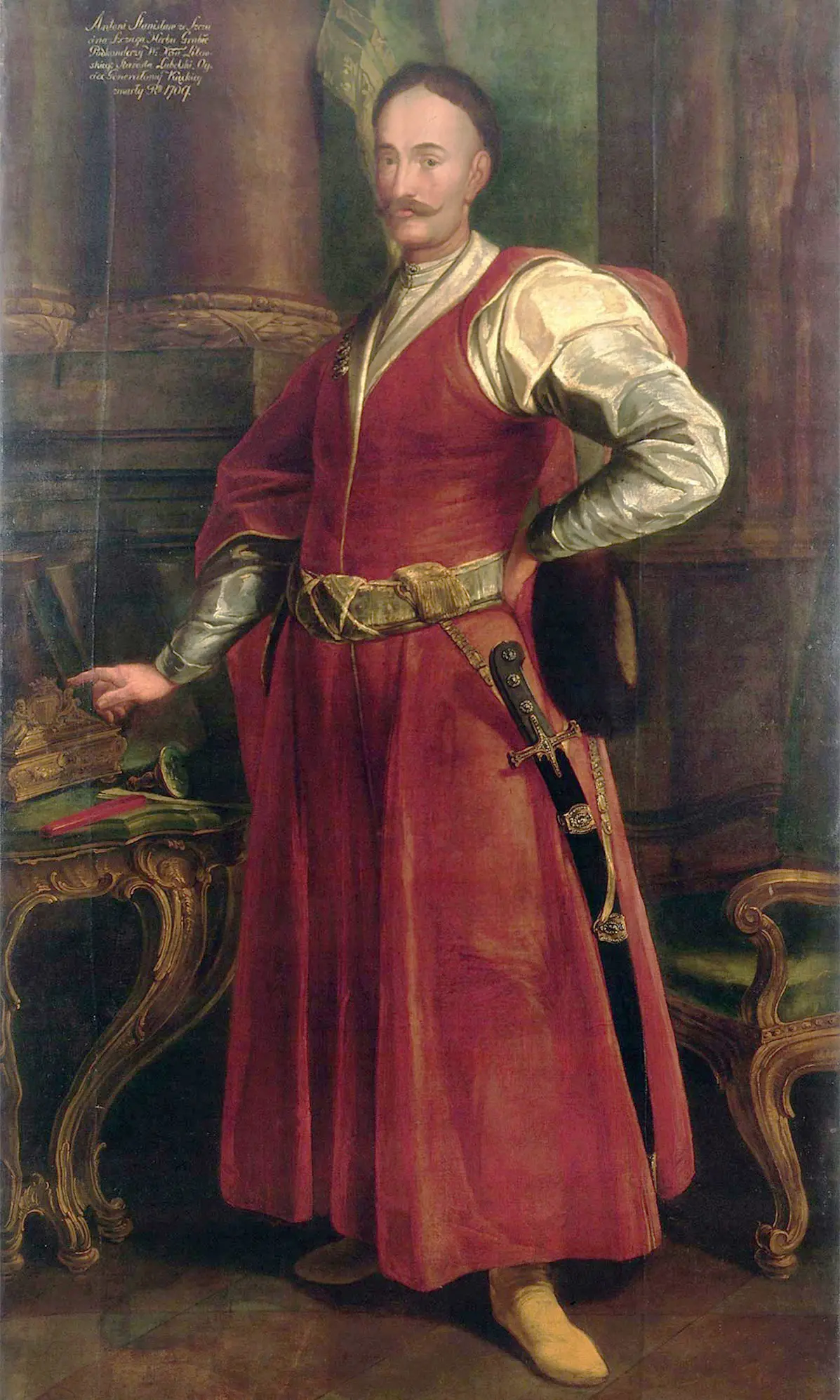
After the death of King John III Sobieski in 1696, Western influence entered Polish noble culture through three main channels. The Saxon court in Dresden, connected to Poland through the union beginning in 1697, exposed nobles to unfamiliar splendor. The French court, reached through figures such as Stanisław Leszczyński and families like Tarło and Jabłonowski, brought fashions, fabrics, and culinary customs from Versailles. English ideas of liberty gained admirers as well, including King Stanisław August Poniatowski. Clothing became a marker of allegiance: the traditional kontusz represented native values, while the Western tailcoat, or frak, signaled foreign influence. Poniatowski drew criticism for wearing Spanish dress rather than Polish attire at his coronation. Young aristocrats, among them Jakub Sobieski and his sons Marek and the future king Jan, undertook educational tours across Europe to learn languages and social customs.
Legal structure and titles within the szlachta
In the medieval period, the Polish knightly estate was divided into three tiers, recorded in the legislation of Casimir the Great and in numerous archival sources. The highest tier consisted of the szlachta proper, also termed miles famosus or nobilis. A middle tier, the władcy or scartabelli, corresponded to the French escuyer or English squire and did not carry hereditary coats of arms. The lowest tier, the panosza, included those described as familiaris, minister, or ministerialis.
The fifteenth century brought the formal end of these distinctions. Lower orders merged partly into the higher nobility and partly into the peasantry, leaving in law a single equal nobility that accepted no internal ranks, titles, badges, or orders. In practice, three informal categories persisted. The panowie, meaning lords, encompassed senators and magnates, originally styled barones regni. The general szlachta bore its own coats of arms and was described as bene nati et possessionati, well born and propertied. A third and much larger group, the lesser nobility, included the zaściankowa, chodaczkowa, and szaraczkowa nobles, some of whom held no land at all. The title of count, or comes, was originally tied to an office rather than passed by inheritance, granted as an honor attached to a specific incumbency rather than a permanent family distinction.
Partitions and the fate of noble titles
The partitions of Poland at the end of the eighteenth century fractured the Commonwealth among the Russian, Prussian, and Austrian empires, and with it the legal continuity of the szlachta. Records of noble status became incomplete and inconsistent across the partitioning powers, a gap still reflected in modern reference lists of Polish titled nobility. As the old legal order collapsed, many families sought formal, hereditary titles, most often that of count, from the courts now governing their territories.
The Grocholski family offers a documented example of this process. Before the Commonwealth’s fall, Marcin Grocholski, castellan of Bracław and a representative of King Stanisław Poniatowski, was informally addressed as graf by Prince Potemkin between 1782 and 1784. Formal recognition came much later, through a resolution of the Russian State Council dated 26 May 1881, granting several Grocholski family members the right to use a count title of the Hungarian and Bohemian kingdoms. The justification cited a supposed decree of 27 September 1469 by the Hungarian king Matthew Corvinus, attributed to an ancestor who had in fact died a decade earlier, in 1459. The claim did not correspond with the historical record, yet it was accepted as fact by the Tsarist administration. Further confirmations followed on 20 April 1890 and 18 November 1898. Cases such as this illustrate how nineteenth century title recognition often rested on administrative convenience rather than verified lineage.
Legacy of the clans in Poland today
The formal legal privileges of the szlachta ended with the political transformations of the twentieth century, yet the heraldic and genealogical record they left behind remains extensive. Coats of arms, family seals, court documents, and parish registers continue to provide a detailed picture of how Polish noble families lived, married, and moved across the territories of the historical Commonwealth. Many surnames in use today still carry the imprint of a clan affiliation formed centuries ago.
Interest in this heritage has grown steadily among descendants of Polish emigrants seeking to understand their family origins. Archives in Poland, Lithuania, and Ukraine hold records connecting present day families to the clans and coats of arms carried by their ancestors, offering a tangible link between contemporary genealogical research and the noble structures of earlier centuries.
Key facts:
- Polish heraldic clans allowed unrelated families to share a single coat of arms, unlike Western European heraldry.
- The Jastrzębiec coat of arms, featuring a hunting horn, was adopted by numerous unrelated noble families.
- The Radziwiłł, Potocki, Lubomirski, Czartoryski, Sapieha, and Zamoyski families were among the most influential magnate houses.
- Sarmatism, the dominant noble ideology from the late seventeenth century, held that a nobleman at his farmstead equaled a voivode.
- Formal legal equality among the szlachta was established in the fifteenth century, ending earlier tiered distinctions.
- The Russian State Council formally recognized the Grocholski count title in 1881, based on a fabricated fifteenth century grant.
Understanding a Polish noble clan or coat of arms often requires access to archival records scattered across Poland, Lithuania, and Ukraine, along with the historical context needed to interpret them correctly. GenealogyTour.com has spent over fifteen years researching Polish family histories and guiding clients to the towns, archives, and communities connected to their ancestry, helping descendants of Polish noble and szlachta families trace their lineage with the documentation to support it.
Sources:
Related Articles
Related
History, Language and Identity of Silesian People
Silesian history between Bohemia, Prussia and Poland, the Silesian language debate, mining traditions and how to trace Silesian ancestors in archives.
Polish Righteous Among the Nations: About Poles Who Saved Jews
Poles faced the death penalty for hiding Jews. Read about Zegota, Irena Sendler, the Ulma family and how Yad Vashem recognises the Righteous.
Warsaw Genealogy: Finding Ancestors in Warsaw Records
Warsaw lost most of its archives in 1944, yet many birth, marriage and death records survived. See what remains and where to search for your ancestors.