
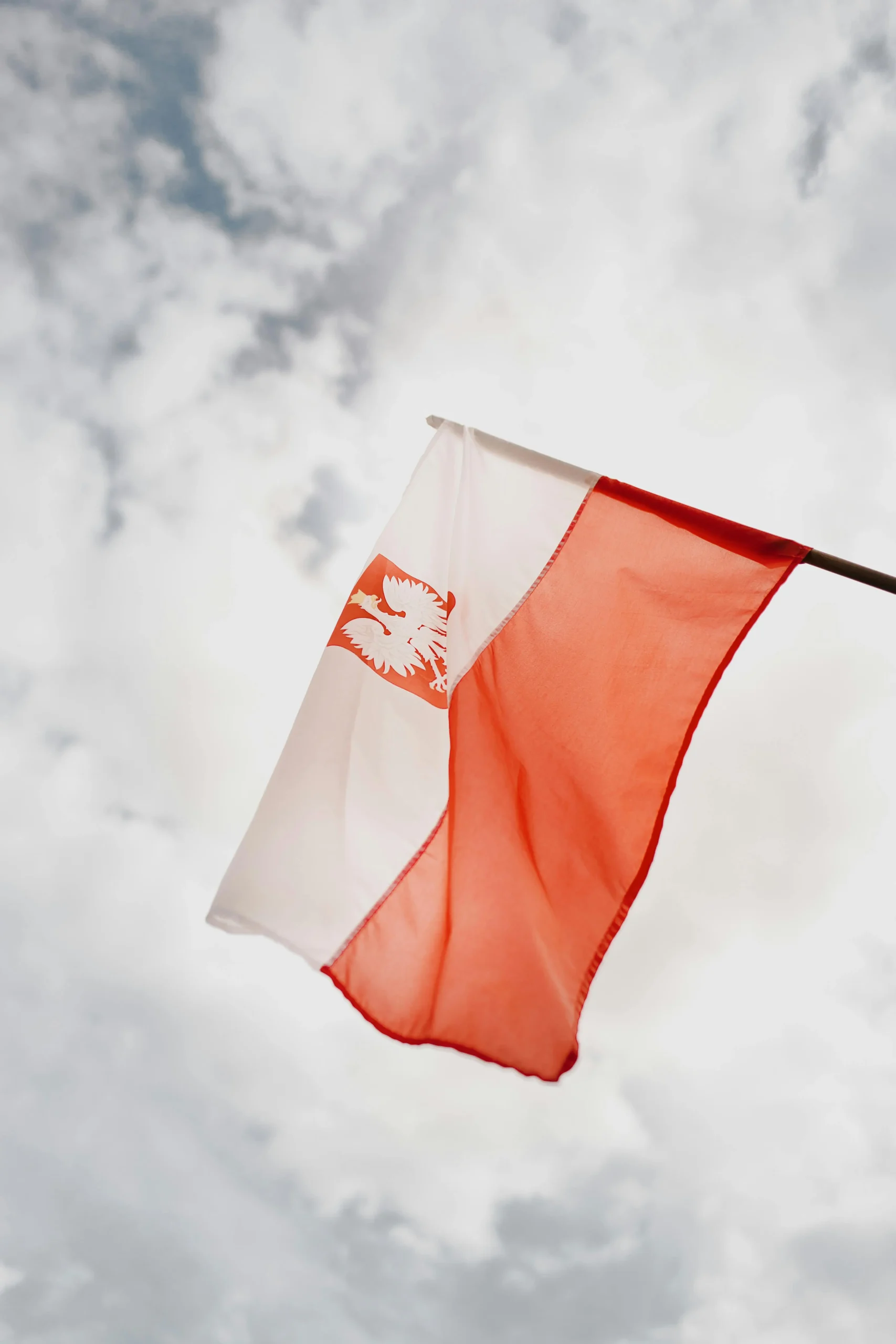
Historical flags of Poland: Colors & symbolism and meaning
Poland’s flags have changed many times over more than a thousand years of statehood, partition, and restoration. Each version reflects a specific period of Polish history: the medieval kingdom, the Polish-Lithuanian Commonwealth, the years of partition, the interwar republic, the Second World War, communist rule, and the modern state. This article traces that sequence in order, explains the origin of the national colors, and describes how the current flag reached its final form.
From Legend to the First Polish War Banner
The association between Poland and the colors red and white originates in the coat of arms rather than in a flag as such. According to an early founding account, the chieftain Lech saw a white eagle guarding its nest against a red evening sky near the River Warta and founded a settlement on the spot, naming it Gniezno, from the Polish word for nest. Gniezno became one of the first centers of Polish statehood and the eagle was retained as its emblem.
The earliest documented version of a white eagle on a red field as a formal state symbol dates to the coronation of Przemysł II in Gniezno on 26 June 1295. At his coronation, the eagle was placed on the royal seal as a symbol of the reunified Kingdom of Poland. Under medieval doctrine, the ruler’s personal emblem represented the state itself, so this banner functioned as the country’s first documented flag. Later Piast rulers, including Władysław I Łokietek, who reunified the fragmented Polish duchies after nearly two centuries of division, and his son Casimir III the Great, continued to use bordered versions of the crowned eagle on their own campaign banners. Władysław II Jagiełło carried a similar royal standard at the Battle of Grunwald in 1410, where the combined Polish-Lithuanian forces defeated the Teutonic Order and secured Poland’s eastern frontier for generations.
Flags of the Polish-Lithuanian Commonwealth
Following the Union of Lublin, signed on 1 July 1569, the Kingdom of Poland and the Grand Duchy of Lithuania were formally joined into a single state, the Polish-Lithuanian Commonwealth. At its height in the late sixteenth and early seventeenth centuries, the Commonwealth covered roughly one million square kilometers, making it one of the largest states in Europe. Its flags and battle banners combined the white eagle of the Polish Crown with the mounted knight, known as the Vytis, representing the Grand Duchy of Lithuania.
Kings elected during this period carried personal battle standards bearing these combined arms. Stefan Batory used his royal banner during campaigns against Ivan the Terrible in the 1580s. Jan III Sobieski flew his own standard at the relief of Vienna in 1683, where combined Polish, German, and Austrian forces broke the Ottoman siege of the city. The political system of the Commonwealth, built on the Nihil Novi Act of 1505 and the principle of noble self-government known as Golden Liberty, gradually weakened the central authority of the monarchy over the following two centuries. By the eighteenth century, this internal decline had left the Commonwealth vulnerable to its neighbors. The state was dismantled through three partitions carried out by the Russian Empire, the Kingdom of Prussia, and the Habsburg Monarchy in 1772, 1793, and 1795. After the third partition, no independent Polish flag existed for 123 years.
What are the old flags of Poland?
Before the twentieth century, Poland had no single civil flag in the modern sense. What is often referred to as Poland’s old flag was armorial: the white eagle placed directly on a red field, used as a royal and military banner rather than as a flag flown by ordinary citizens. Variants of this armorial pattern followed the Commonwealth through the eighteenth century, including the combined banner used under the last king, Stanisław August Poniatowski, until the final partition in 1795.
This armorial pattern briefly reappeared after the First World War, when several Polish nationalist and paramilitary organizations used a red flag bearing the white eagle during the fight for independence between 1914 and 1918. That version was ultimately set aside in favor of a plain horizontal bicolor. On 1 August 1919, the Legislative Sejm of the newly restored Second Polish Republic formally adopted the white-over-red flag that, with interruptions during the Second World War, has remained Poland’s national flag ever since. During the German and Soviet occupation from 1939 to 1945, the legal government in exile and its underground delegation continued to use this flag, while the Home Army, the main resistance organization, adopted its own combined anchor symbol as a mark of ongoing Polish sovereignty, most visibly during the Warsaw Uprising of August and September 1944.
Why Are There Two Flags for Poland?
Poland currently uses two recognized versions of its flag, and both remain legally valid today. The plain flag, consisting of a horizontal white stripe above a red stripe, is the state flag used domestically by government institutions, public buildings, schools, and private citizens. The second version adds the national coat of arms, the crowned white eagle, to the center of the white stripe.
This second version is reserved for specific official purposes rather than for general public use. It is flown by Polish diplomatic missions abroad, including embassies and consulates, and used on merchant vessels registered under the Polish flag, on certain military units, and during selected state ceremonies. The distinction between the two flags is therefore a matter of formal designated use, not a regional or historical variant chosen at will. Both versions share the same colors, proportions, and legal status, and both trace back to the same 1919 adoption of the white-over-red design.
What Does the Polish Flag Look Like?
The Polish flag consists of two horizontal stripes of equal height, white on top and red below, with an official width-to-length ratio of 5 to 8. The choice of colors corresponds directly to the coat of arms: white comes from the eagle, red from the field behind it. According to some accounts, the pairing was also intended to create a clear visual contrast with the black eagle on a gold field used by the neighboring Holy Roman Empire.
The flag’s basic design has remained visually unchanged since its adoption in 1919, with one significant exception concerning the coat of arms variant. After the Second World War, the communist authorities that took power under Soviet backing removed the golden crown from the eagle’s head, treating it as a symbol of monarchy incompatible with the new political order. Opponents of the regime argued that the crown represented statehood and sovereignty rather than royal rule, but the change remained in place throughout the period of the Polish People’s Republic. The crown was formally restored to the coat of arms in 1990, following the fall of communist rule and the return of full Polish sovereignty, and the flag bearing the crowned eagle has been used in its current legal form since that date.
Key Dates in the History of the Polish Flag
- 1295: Przemysł II is crowned in Gniezno and adopts the white eagle on a red field as the royal seal.
- 1410: Władysław II Jagiełło carries the royal standard at the Battle of Grunwald.
- 1569: The Union of Lublin formally establishes the Polish-Lithuanian Commonwealth.
- 1772 to 1795: Three partitions by Russia, Prussia, and Austria erase the Polish state from the map.
- 1919: The Second Polish Republic adopts the white-over-red civil flag on 1 August.
- 1944: Communist authorities remove the crown from the eagle on the state emblem.
- 1990: The crowned eagle and full state sovereignty are restored.
The flags of Poland record specific, dated events rather than abstract tradition: a coronation in 1295, a union in 1569, three partitions between 1772 and 1795, a formal adoption in 1919, and a restoration of the crowned eagle in 1990. For families researching Polish ancestry, these dates often correspond directly to the periods and administrative records relevant to their own family history, from the parish registers of the partition era to the civil records of the interwar republic. At GenealogyTour, we help clients place their family research within this historical framework, connecting archival documents with visits to the regions and institutions where that history unfolded.
Sources:
Related Articles
Related
History and Evolution of Slavic Languages
Trace the origins of Slavic languages, from Proto-Indo-European roots to the modern languages spoken across Europe today.
The history and meaning of unique Polish symbols
Discover the history behind Poland’s white eagle, flag, and anthem, and what these national symbols mean. A GenealogyTour guide to Polish heritage.
Anders Army Soldiers List and Records
Learn why Jews settled in Poland, how communities grew, and how law, trade and tolerance shaped Jewish life over centuries.